
Explore the political and religious heart of ancient Rome. Expert-led guided tours, what to see, opening hours and practical tips from those who know it best.
Explore Experiences ➔ⓘ Disclaimer This site (fororomano.roma.it) is an independent informational guide. It is not the official website of the Colosseum Archaeological Park or any government body. Prices and information are provided by third-party platforms and may vary. Always verify on the official website.
| Address | Via della Salara Vecchia, 5/6 — 00186 Rome |
|---|---|
| Total area | Approx. 2 hectares (part of the Colosseum Archaeological Park) |
| Hours | Daily 9:00 — closing varies (16:30 winter / 19:15 summer) |
| Last entry | 1 hour before closing |
| Guided experiences | From €30–50 per person (with expert guide) |
| Combined route | Roman Forum + Colosseum + Palatine Hill |
| Visit duration | 1–2 hours (Forum) | 3–4 hours (full route) |
| Nearest metro | Colosseo (Line B) — 5 min walk |
Information based on the official website of the Colosseum Archaeological Park. Always verify before your visit.
The Roman Forum is far more than a pile of ruins. For nearly a thousand years — from the 7th century BC to the 7th century AD — this rectangle of land between the Palatine and Capitoline Hills was the nerve centre of Roman civilisation. Wars were decided here, triumphs were celebrated here, justice was administered here, gods were worshipped here. Julius Caesar was cremated here. Cicero addressed the crowds here. Marcus Aurelius meditated on mortality here.
The problem? Without a guide, you see broken columns, roofless walls and pedestals without statues. With an expert at your side, those same stones come to life. The Via Sacra becomes the triumphal route of victorious generals. The three pillars of the Temple of Castor and Pollux tell the story of the miracle at the Battle of Lake Regillus. The Arch of Titus shows the sacking of the Temple of Jerusalem, carved in marble 2,000 years ago.
I have visited the Roman Forum at least 30 times. The first 5, alone, I was bored after half an hour. From the sixth, with a guide, I discovered that every stone has a story that changes the way you see the world. The Forum is the place where democracy, law and modern engineering were born. But to understand it, you need someone to tell you its story.
— Editorial Team, ForoRomano.roma.it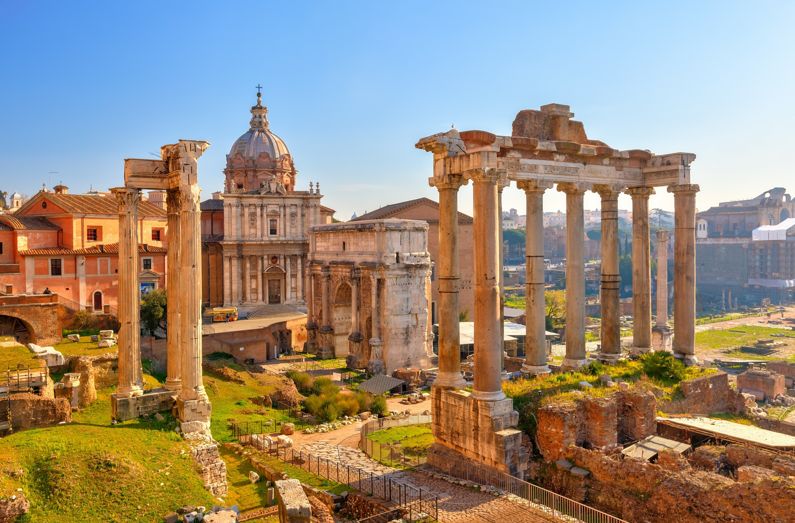
The oldest and most important road in Rome, along which the triumphal processions of victorious generals passed. It starts at the Arch of Titus and crosses the entire Forum up to the Capitoline Hill. Walking the Via Sacra means placing your feet on the same stones trodden by Caesar, Augustus and Trajan.
Erected to celebrate the conquest of Jerusalem by Emperor Titus in 70 AD. The internal reliefs show the transport of the spoils from the Temple of Jerusalem, including the famous seven-branched Menorah. It is one of the most important historical documents of antiquity.
The eight Ionic columns that dominate the western side of the Forum belong to one of the oldest temples in Rome (497 BC). Saturn was the god of agriculture and wealth — the temple also served as the State treasury (aerarium). The Saturnalia, the winter festivities that inspired Christmas, were celebrated here.
The largest building ever constructed in the Forum. Three enormous barrel vaults (35 metres high) are all that remains of this colossal structure. To give an idea of the scale: the central nave was larger than the entire Basilica of Santa Maria Maggiore. Michelangelo studied these vaults before designing the dome of St Peter's.
The circular temple dedicated to Vesta, goddess of the domestic hearth, housed the sacred flame of Rome — never allowed to go out for over a thousand years. The Vestal priestesses, virgins chosen from patrician families between the ages of 6 and 10, served for 30 years. Their house (Atrium Vestae) is one of the best-preserved residences in the Forum.
A three-bay triumphal arch, 20.9 metres high, celebrating the Emperor's victories over the Parthians. The reliefs depict the military campaigns in Mesopotamia. It is one of the most photographed monuments in the Forum.
The brick building where the Roman Senate met. The interior, surprisingly well preserved, shows the polychrome marble floor and the steps where 600 senators sat. Here Caesar was declared perpetual dictator. Here Augustus presented his reforms. The heart of Roman politics for centuries.
One of the best-preserved temples thanks to its conversion into a Christian church (San Lorenzo in Miranda) in the 7th century. The six Corinthian columns in cipollino marble and the frieze with griffins and candelabras are original.
Only three Corinthian columns 12.5 metres high remain — but they are among the most iconic in Rome. According to legend, Castor and Pollux appeared at the Forum after the Battle of Lake Regillus (499 BC), announcing the Roman victory.
An area of black marble paving that, according to tradition, marks the site of the tomb of Romulus, the legendary founder of Rome. Excavations revealed a 6th century BC sanctuary with an archaic Latin inscription — one of the oldest Latin texts ever found.
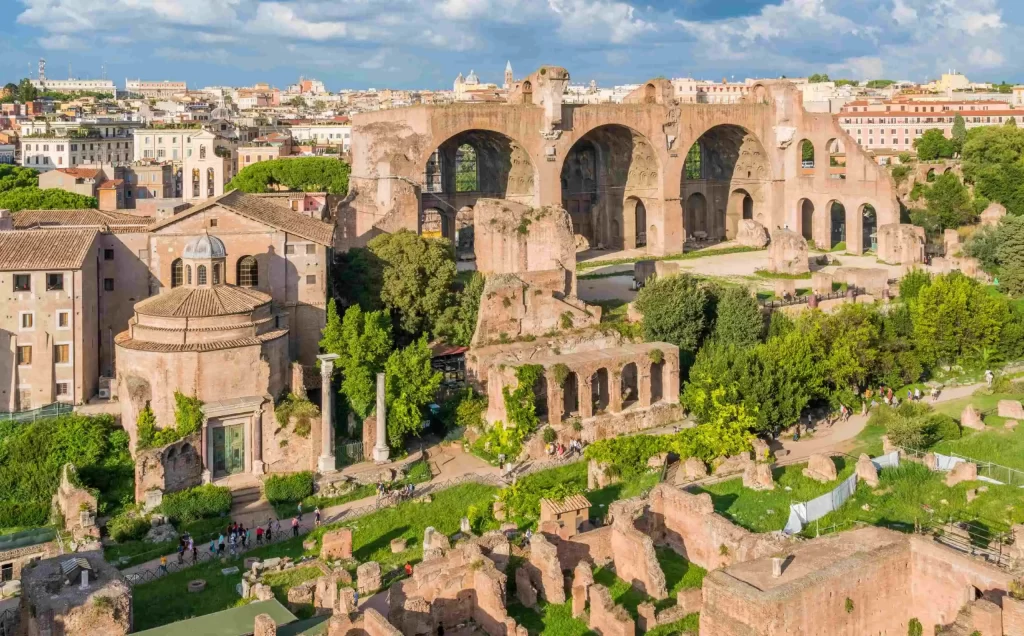
The Roman Forum is part of the Colosseum Archaeological Park, which also includes the Colosseum itself and the Palatine Hill. The three areas are connected and visited on a single integrated route. A complete guided experience covers all three areas in 3–4 hours.
| Area | What to See | Recommended Time |
|---|---|---|
| Colosseum | Arena, underground, upper levels, gladiator history | 1–1.5 hours |
| Roman Forum | Via Sacra, temples, triumphal arches, Curia | 1–2 hours |
| Palatine Hill | Imperial palaces, House of Augustus, Stadium, panoramas | 45 min–1 hour |
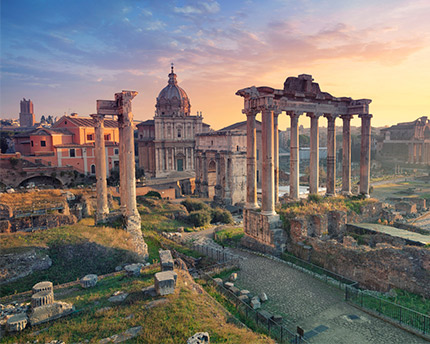
For the Forum alone: 1–2 hours. For the full route (Colosseum + Forum + Palatine): 3–4 hours with an expert guide. We recommend devoting at least half a day to appreciate all three areas.
Yes, but with some considerations. The open space is stimulating for children, but the uneven ground requires care with pushchairs. Some guided experiences are specifically designed for families with children, with adapted explanations and shorter routes.
Accessibility is partial. Some areas of the Forum are reachable by wheelchair, but the uneven ground and steps make a complete visit difficult. A partial accessible route is available. Contact the Archaeological Park for updated information.
With a guide, without doubt. The Roman Forum is a complex site with over 30 structures spread across a large area. Without historical context, it is difficult to distinguish a temple from a basilica or understand the significance of the ruins. An expert guide transforms the visit from “beautiful ruins” to “an immersive experience in history.”
Yes, there are some drinking fountains (nasoni) inside the archaeological area and nearby. However, in summer the number may not be sufficient. Always bring a full water bottle.
Yes, the Forum is an open-air site and remains open in any weather conditions (except extreme events). A lightly rainy day can be an excellent choice: fewer crowds and atmospheric light for photos. Bring a light waterproof jacket.
The Roman Forum is the place where the history of the Western world began. With an expert guide, every stone tells its story. Explore the available guided experiences and book your experience.